
Raj Thackeray questions BJP’s ‘Save Democracy’ marches amid Gokul Dairy row
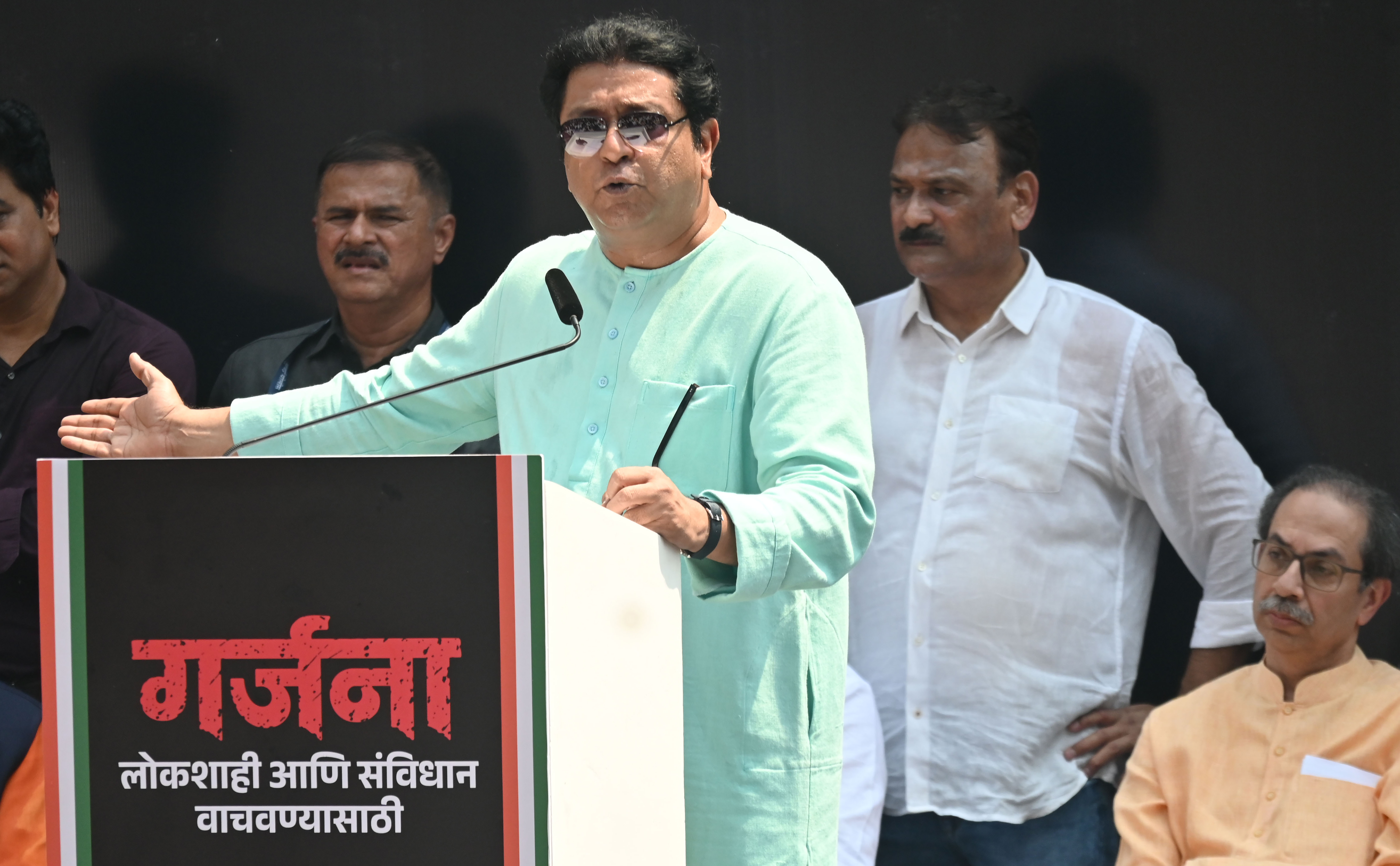
Raj Thackeray questions BJP’s ‘Save Democracy’ marches amid Gokul Dairy row Mumbai, Nov 6 (IANS) The Maharashtra Navnirman Sena (MNS) chief Raj Thackeray on Friday launched a fiery broadside against the Bharatiya Janata Party (BJP), taking sharp jabs at the ruling party for holding nationwide ‘Save Democracy’ marches while aggressively “bypassing democratic mandates to capture local power bodies”.
Taking aim at the paradox of a ruling establishment taking to the streets against the opposition, Thackeray questioned the party’s intent, highlighting its recent manoeuvring in the Kolhapur District Cooperative Milk Producers’ Union (Gokul Dairy) elections. Mocking the BJP’s strategy, Thackeray pointed out the irony of a party holding absolute power from the central to the local levels organising protests under the guise of saving the Constitution.
“The Bharatiya Janata Party is a truly bizarre party. Even though it is in power from top to bottom, it is still taking out marches to ‘save democracy’. This must be the only example in the world where the ruling party takes out a march against the opposition,” he remarked. Taking a sarcastic swipe at the BJP’s campaign, Thackeray compared a ruling party claiming to “save democracy” to the “iconic KFC logo mascot campaigning to save chickens”.
He accused the BJP of failing to shed its opposition mindset despite holding office for over a decade. To demonstrate what he termed the BJP’s “double standards,” Thackeray brought up the recent fallout in the Gokul Dairy Board elections. In the elections, the opposition panel led by Congress leader Satyajit Patil secured 13 seats out of 25, defeating the BJP-backed panel, which secured 12.
However, following the defeat, the state government moved to nominate five government directors with voting rights — a tactic widely criticised as an attempt to artificially flip the majority, he noted. “If you truly have such a strong desire to preserve the roots of democracy, then in the Gokul case, after your BJP panel’s 12 members lost to Satyajit Patil’s panel’s 13 members getting elected, why did you immediately appoint 5 directors from the government and give them voting rights? What exactly are you trying to prove with that?” he asked.
Thackeray asserted that because the BJP could not win power over Gokul through democratic ballot voting, it cast aside its principles and resorted to administrative interference –exposing the hypocrisy of its street protests. Critiquing the government’s priorities, the MNS leader drew a grim comparison between Maharashtra’s current environmental crises and its political climate. “Right now in Maharashtra, there’s a severe drought of water and a severe drought of common sense in the Bharatiya Janata Party happening at the same time — it’s astonishing how that can occur!” he said.
Thackeray alleged that the BJP routinely orchestrates protests to deflect from its own governance failures — marching to “save the country from terrorism” after security lapses occur under its watch, or marching to “save the economy” after destabilising financial growth. Thackeray urged the ruling party to accept electoral setbacks with grace, reminding them that political tides inevitably turn.
“The Bharatiya Janata Party should stop playing the pity card. Whichever path you took to gain that majority, all the opposition parties endured it for 12 years — so now, if the people of this country are starting to lean toward the opposition parties, the BJP should learn to endure it as well,” he said. Earlier, Congress MLC Satej Patil on Thursday launched an attack on the Mahayuti government over its decision to appoint five state-nominated members — including four non-official directors — to cooperative unions such as the Gokul Milk Union (Kolhapur Zilla Sahakari Dudh Utpadak Sangh).
These four non-official directors will be granted voting rights. Lashing out at the Cabinet’s decision during a press conference in Mumbai, Satej Patil took a defiant stand, declaring that he will take to the streets for Gokul. He announced a mass protest rally on November 9 from Dasara Chowk to the Kolhapur District Collectorate. “There is a clear conspiracy to hand Gokul over to Amul. The government is working actively to dismantle the state’s democratic framework,” he alleged.
Patil questioned the government’s intentions. “Just because the election results didn’t go in your favour, you change the laws. If law changes were needed, they should have been made before the election. They claim they are appointing ‘expert’ directors — yet those very people were rejected by the voters. If they were truly experts, the public wouldn’t have defeated them. Our legal battle against this will continue,” he said.
Patil claimed the government is altering the law simply because the results did not turn out in the Mahayuti’s favour. Any legal modification should have been enacted prior to the elections. The government is naming candidates as “expert” directors who were explicitly rejected by the electorate. If they possessed true expertise, the voters wouldn’t have voted them out. Meanwhile, Nationalist Congress Party (NCP) leader and Cabinet Minister Hasan Mushrif strongly defended the government’s move, stating that the intervention was necessary to break a political deadlock and preserve democracy within the institution.
Explaining the rationale behind the decision, Mushrif highlighted the unique mandate given by the members during the recently concluded elections. “The voters gave a very unusual verdict in the Gokul Dairy elections — 13 seats went to Congress and 12 seats to the Mahayuti alliance. According to the co-operative body’s bylaws, a quorum of 14 members is mandatory to convene a meeting and elect the chairman.
Since 12 members remained absent, the quorum could not be met, preventing the chairman’s election,” Mushrif stated. He added that if the meeting were to be adjourned repeatedly due to the lack of a quorum, the rules under the Maharashtra Co-operative Societies Act would mandate the appointment of an administrator, followed by fresh elections. “Should we, as an opposition of 12 members, simply attend the meeting and help them appoint their chairman? That is not the mandate the public gave us.
They placed us in the opposition. This created a deadlock that exists nowhere else. It was the government’s responsibility to step in, resolve this deadlock, and ensure that power remains in the hands of the 25 elected representatives rather than an administrator, safeguarding the interests of 5.5 lakh dairy farmers,” Mushrif argued. –IANS sj/dpb